Hidden
Traces
Investigating Allegations of Covert Belgian Military Aid to the DRC
Gabòr Friesen
Centre for Research Architecture · Goldsmiths, University of London · 2026
SummaryThe Summary
Since 2004, there has been a series of conflicts in the eastern part of the Democratic Republic of the Congo (DRC), in particular in the provinces of North and South Kivu. These provinces are rich in natural resources and are on the border with Burundi, Rwanda, and Uganda.
The current phase is known as the M23 Campaign. It began in 2022 when the “March 23 movement,” a paramilitary group supported by Rwanda, launched an offensive in North Kivu and slowly gained ground. In 2025 they renewed their offensive and rapidly gained ground. Western nations backed the DRC against the insurgents, which led to several diplomatic incidents with Rwanda.
Belgium, as the historical colonial power in the region, has been particularly involved in Central African affairs. They have pushed heavily for implementing diplomatic measures against M23 members since the 2022 offensives. In 2025, they were accused of various different kinds of covert military support to the DRC by the Rwandan media outlet “The Great Lakes Eye.”
This report investigates flight movements to help determine the accuracy of these allegations. It investigates aircraft movements from the Belgian Air Force in Africa to try to detect unusual activities that may represent the presence of covert operations. The report finds that there is no clear evidence to help back the allegations. Nevertheless, it also concludes that there are suspicious movements by the Belgian Air Force. To fully dispel the allegations, Belgium would need to provide a convincing explanation for the purpose of those suspicious flights.
Chapter 1Background
1.1The Allegations
On October 2nd, 2023, the Rwandan news outlet “The Great Lakes Eye” accused Belgium of picking the DRC’s side in the Kivu conflict. In July of that year, Belgium had declined to accredit Vincent Karega as the Rwandan ambassador to Brussels.1 In September, the Rwandan president Paul Kagame claimed that this refusal was at the request of the DRC’s government.2
Since then, The Great Lakes Eye has published many articles that discuss Belgium’s potential involvement in the Kivu conflict. However, the severity of the lodged accusations increased massively on March 24th, 2025 when they accused Belgium of deploying 300–400 “troops, tanks and drones to the Democratic Republic of Congo (DRC) to train and reinforce the Congolese army, FARDC, Wazalendo millitia, and the Rwandan genocidal militia, FDLR, to eliminate AFC/M23 rebels who now control swathes of territory in the east of the country.”3 These allegations were sparked by a series of Belgian Air Force flights to the DRC. On the way, these flights made a stop in Zaragoza, which The Great Lakes Eye later claimed was to reload military equipment.4 On April 4th, this was followed by a claim that, since March, “at least eight Belgian soldiers have died in Walikale territory, in North Kivu.”5 Among them was a soldier supposedly called “Sgt Jimmy Luis Flander.”6 On May 7th, they claimed that “on May 1 and 2, two Belgian drones conducted reconnaissance and intelligence-gathering operations in Walikale and Masisi territories”.7 In the same article, they claimed that on May 2nd “Belgian Unmanned Aerial Vehicles (UAV) Squadron relocated five CH-4 drones from Kinshasa to Bujumbura via Kalemie, in Tanganyika province.”8 On September 9th, this was followed by claims that “Belgian soldiers are behind drone strikes in South Kivu province.”9
At the same time, The Great Lakes Eye published several articles claiming that Belgium was also involving Burundi in the conflict. Supposedly using their airport as a regional base10 and holding secret talks about the possibility of combined military operations.11
1.2The Response
The Belgian minister of Foreign Affairs, Maxime Prévot, quickly responded to these allegations from the Great Lakes Eye.12 He considered it a grotesque fake news story. Instead, he emphasised that there were only 6 Belgian troops in Kindu to implement EU support with non-lethal equipment. He also stated that Belgium had no intention of participating in any kind of military operations, now or in the future.
He also immediately responded to the Rwandan decision to cut off diplomatic relations. He stated that Belgium regretted the decision of Rwanda and that they considered it disproportionate to act like this instead of entering a discussion.13
1.3The Knowns
The information that is currently known matches the response by Minister Prévot. According to the EU’s legislation, the funding and physical presence are meant to “provide basic, non-lethal individual equipment, such as commando kits, first aid kits and clothing, and collective equipment, such as counter-IED kits, vehicles and radios, for the 31st Rapid Reaction Brigade of the FARDC. The assistance measure will also support the rehabilitation of the brigade’s headquarters.”14
According to a fact check by Euronews, which used information from the Belgian government, there should be around 10 Belgian soldiers in Kindu to help implement the EU’s plans and train Congolese troops.15
Furthermore, The Great Lakes Eye is often considered a propaganda outlet for Rwandan fake news. In a report on Central Africa, the Critical Threats think tank described them as a “Pro-M23 investigative outlet.”16 Because of these reasons, to the extent that I have been able to find, no independent investigation into these allegations has occurred.
However, Belgian defence minister Theo Francken has made it clear that he wants Belgium to get involved in the critical minerals trade in Africa. To help get involved, he has made it clear that he wants to set up an increased military presence in Africa.17 He believes that Belgium, with its aerial transport capabilities, is in a unique position to help African countries with their logistics.18 According to him, this military commitment is meant to yield political leverage in a number of other situations.19
Next to that, as seen in Figures 1 and 2, over the past few years, the amount of attention paid to the DRC by Belgian ministers has increased. At least in terms of the amount of public statements made about the DRC. On top of that, the topic has also gradually shifted away from generic meeting announcements towards military matters and the importance of the DRC’s natural resources, likely due to the renewed M23 offensive and the rise of new technologies. Nevertheless, this might also mean that Belgium has become more likely to provide military aid.
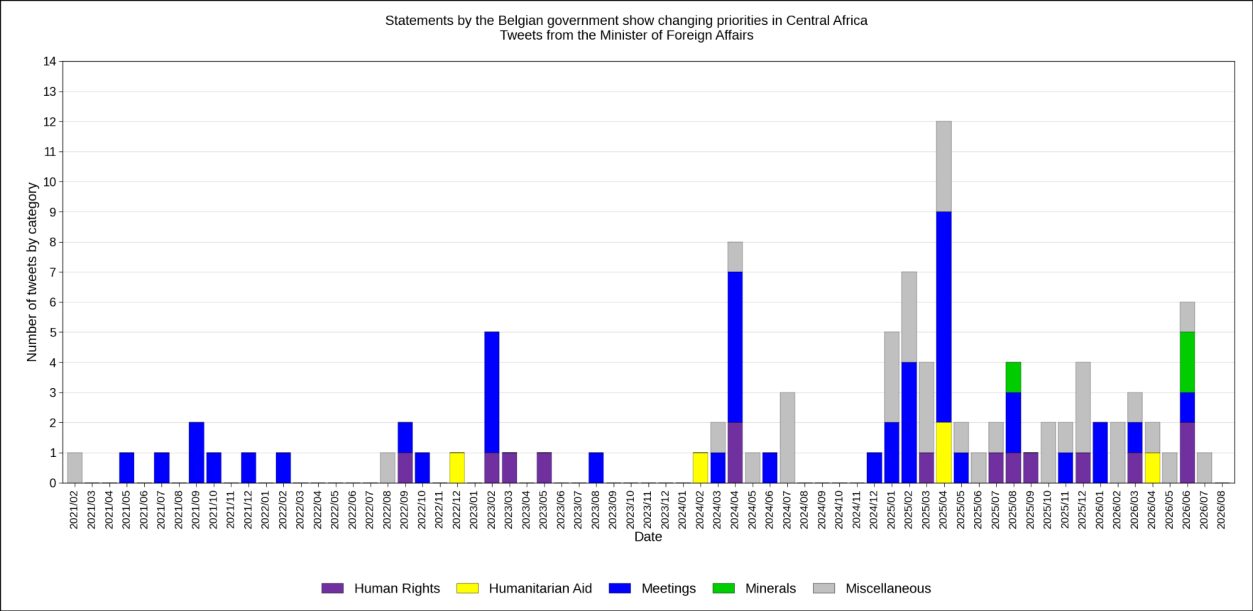
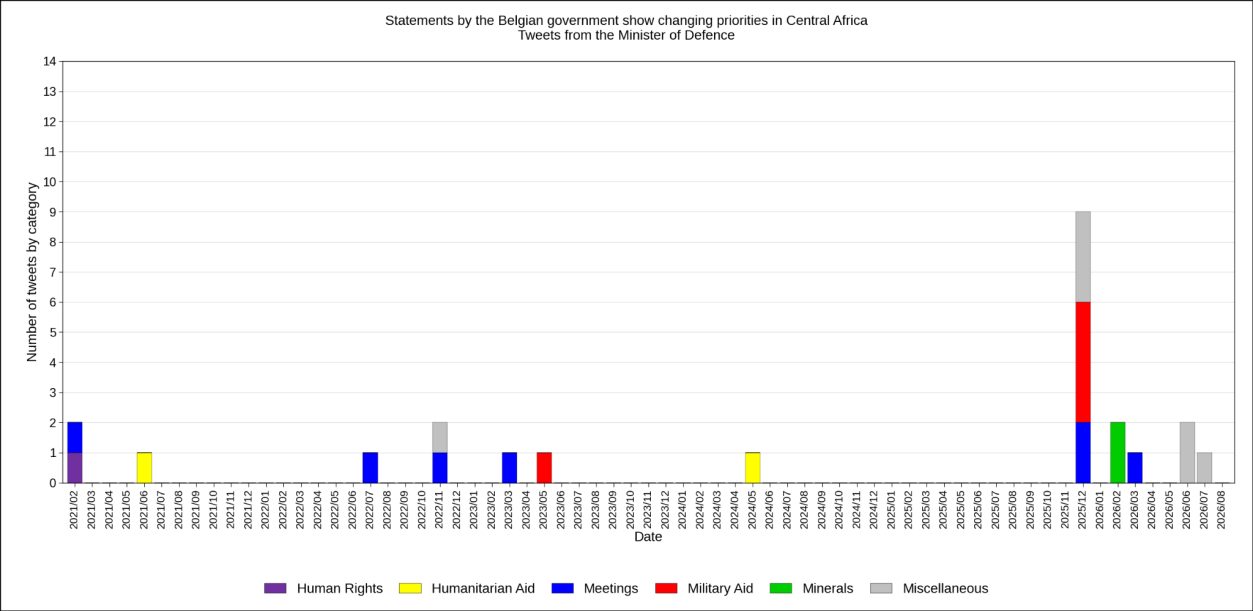
Because of these factors, it may be worth investigating whether there might be some level of truth to these allegations.
Based on the different articles by the Great Lakes Eye, the following researchable claims can be created:
- Belgium is using the Zaragoza airbase as a logistics hub for military shipments.
- Belgium sent tanks to fight in the DRC.
- Belgium sent military equipment to the DRC.
- Including the transport of five CH-4 drones from Kinshasa to Bujumbura via Kalemie on May 2nd, 2025.
- Belgium sent 300–400 troops to fight in the DRC.
- At least 8 of those soldiers have been killed, including one called Jimmy Luis Flanders.
- Belgium uses Burundi as base for military logistics.
- Belgium has had covert talks with Burundi military officials.
Chapter 2Analysis
An easy way to organise an analysis of arms shipments is by phases. The equipment originates in a certain country. It then gets sold to someone else. Afterwards, it has to be transported to that person. Finally, the weapons are used.
In this case, there are no records of recent weapons transfers from Belgium, or other European countries, to the DRC. According to the SIPRI arms transfers database, the most recent (known) order was for 160 Reva-5 armoured personnel carriers from South Africa, in 2024. The most recent delivery was of 10 BATT tactical armoured vehicles, likely from the United States. These were delivered in 2024.20 As the allegations concern covert aid from one government to another, it would make sense that the weapons did not need to be sold. Therefore, any paper trail of their movements would be hidden from the public.
Normally, the next step would be to look at the use of potentially smuggled weapons. A cursory analysis of social media posts and news videos also does not show any Belgian soldiers in combat. To track the origin of specific weapons, such as rifles, their serial numbers are needed. These are also not visible on the publicly available imagery.
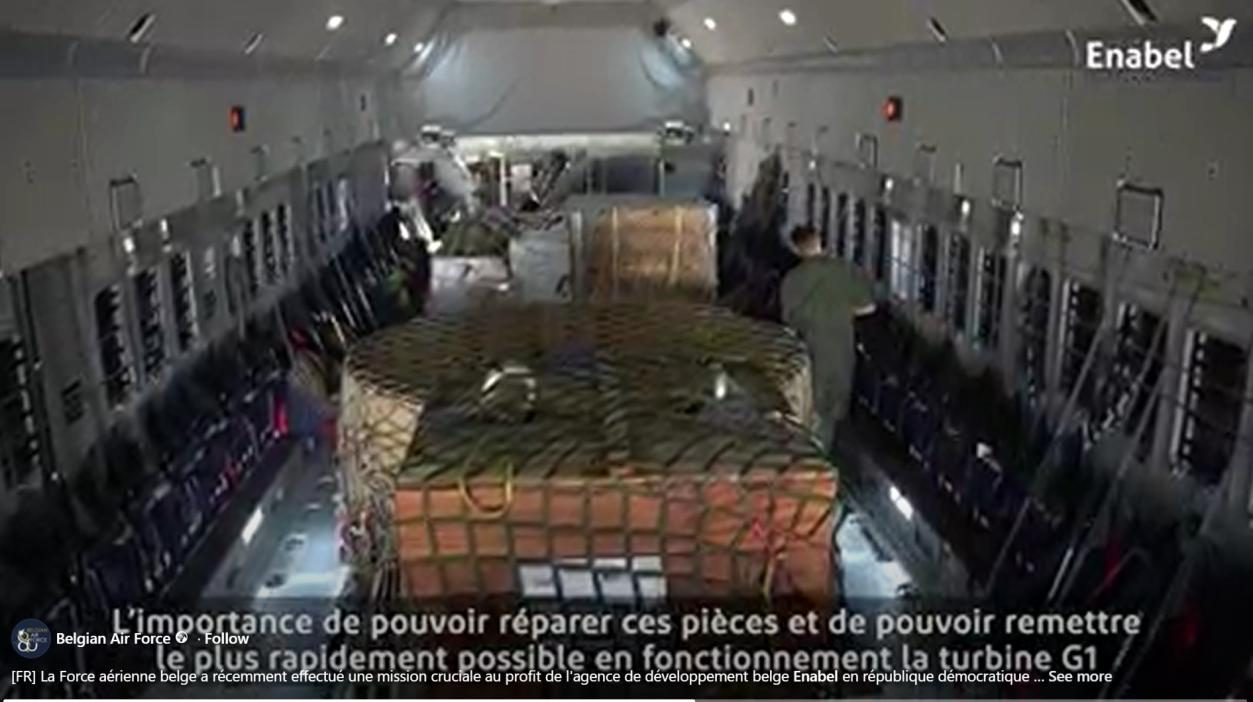
This leaves the transport phase. There does not appear to be any social media imagery showing military goods being transported. Official sources have only shown humanitarian aid being delivered. One example is the transportation of a Hydro-Electrical turbine from Kisangani to Lubumbashi in 2023, so that it could be repaired, before it was flown back to Kisangani (Figure 3).
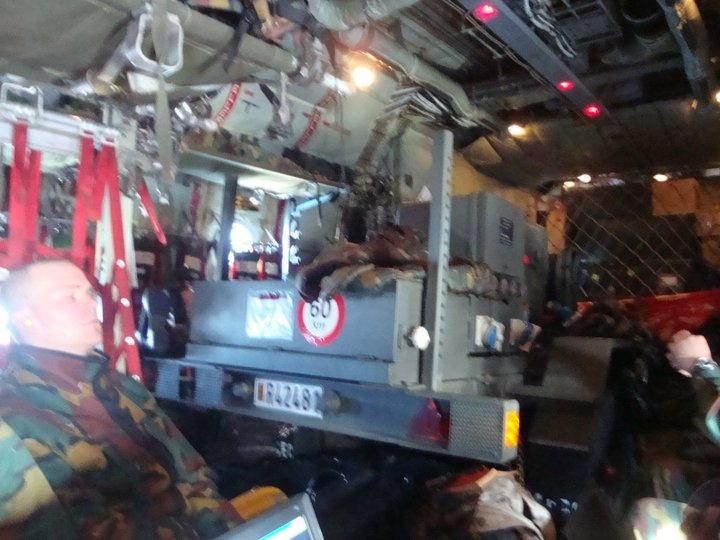
An alternative option might have been to hope that soldiers might have accidentally posted images of the cargo themselves. Only one case from 2011 was found (Figure 4). The soldier showed images of the airport, and one image from inside the plane as it was en route to the DRC. Instead of weaponry, the only visible object is a trailer carrying an electric generator.
All of that does not mean that there is definitely no public paper trail or evidence on social media, it simply means that, if it exists, it is hard to find. Instead, we must find another entry point. In this case, the allegations clearly point out the role of the Belgian Air Force in transporting the equipment and troops.
2.1The Flights
Aircraft movements can be monitored. By mapping them out across space and time, it becomes possible to detect patterns. Once patterns are established, you can identify unusual activity. Any unusual activity can be analysed and compared to other known information to determine whether there is a good explanation, or not. When an explanation is missing, that is a sign that you might want to look deeper into that flight.
Thus, the next step in the analysis is to map out Belgian Air Force movements and correlate them to known events and activities. When there is an unusual movement or pattern, this can be followed up with more targeted research to determine why it occurred. This targeted research may provide evidence to prove one or more of the allegations.
Importantly, this type of analysis cannot categorically disprove the allegations. Even when all movements are analysed, to the largest extent that is possible with the available information, it may be the case that the movement was so well hidden that it left no available traces. If no evidence is found to prove an allegation, only probabilistic conclusions can be drawn about the allegations. An allegation may be considered anything from severely unlikely to proven, depending on what potentially suspicious movements are identified and what further information is found about these movements. However, it can never be disproven.
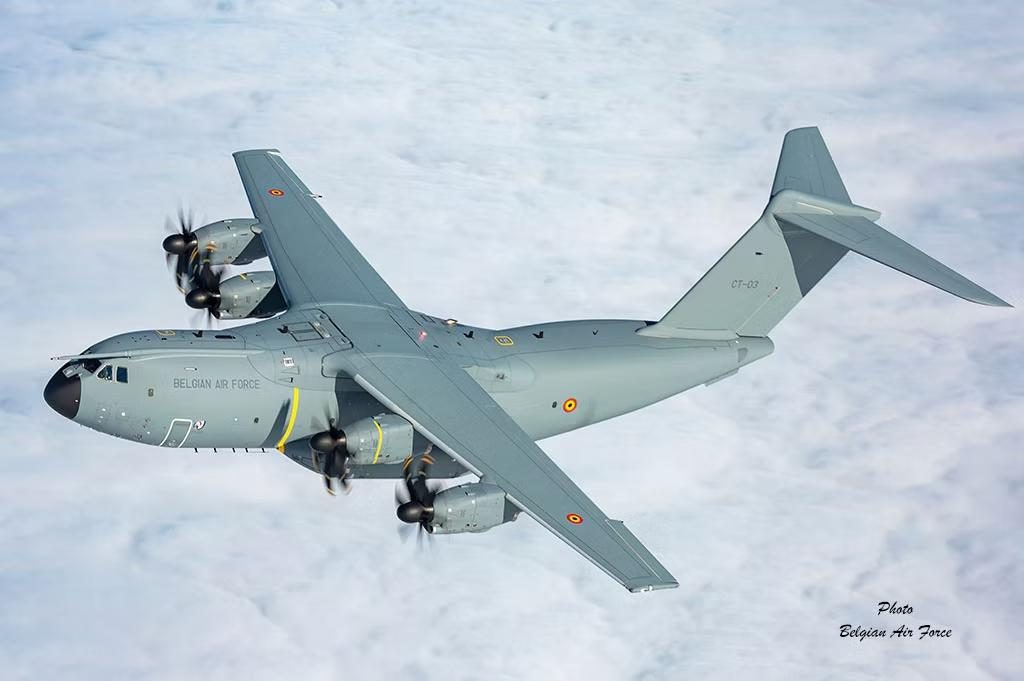
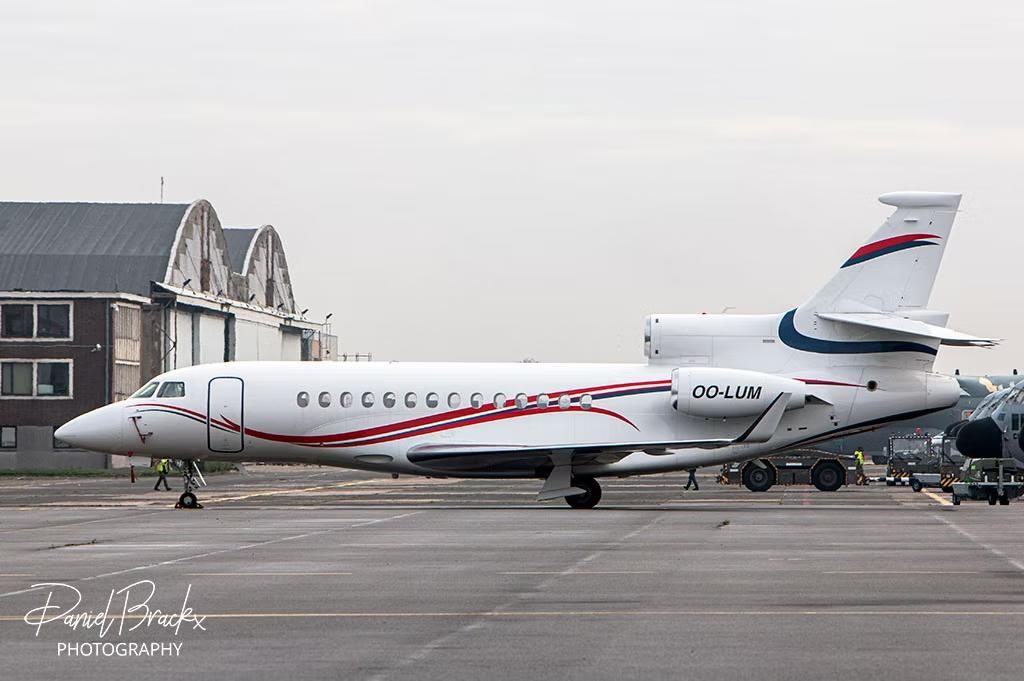
The Belgian Air Force consists of 8 A400M transport aircraft (Figure 5) and 2 Dassault Falcon 7X (Figure 6) planes for VIP transport. The registration numbers for the A400Ms range from CT-01 to CT-08 and the two Falcons go by OO-FAE and OO-LUM.
Their movements can be largely tracked through their ADS-B signals emitted by their transponder. There are people who set up their own ADS-B receivers and then upload this information to sites such as Flightradar24 and ADS-B Exchange.21 Some highly remote areas are not covered by antennas, and in special situations aircraft may turn off their ADS-B signals. However, in almost every case their takeoff and landing will be recorded. Cases where the transponder was turned off, especially when the takeoff or landing is obscured, are clear signs of unusual forms of military activity.
Historical records of this data are not easily accessible. They can be downloaded, but that requires large amounts of storage. However, Flightradar24 provides a 3 year history for their highest level of access. This was used to create a database containing all movements of flights that visited at least one African airport during this period. In cases where the Flightradar24 data was incomplete, when possible, data from ADS-B Exchange was used to fill in the gaps. This database was first stored as an Excel sheet, a portion of which can be seen in Figure 7. Each aircraft was given a separate column and their flight movements from airport to airport were tracked on a daily frequency. Unclear points of origin or destinations were marked with a ?. The allegations only concern a limited portion of this period. However, the rest of the data, especially the period before the allegations, helps establish a baseline of “normalcy” which can be used to determine patterns. These patterns are needed to reliably point out unusual movements during the allegation period.
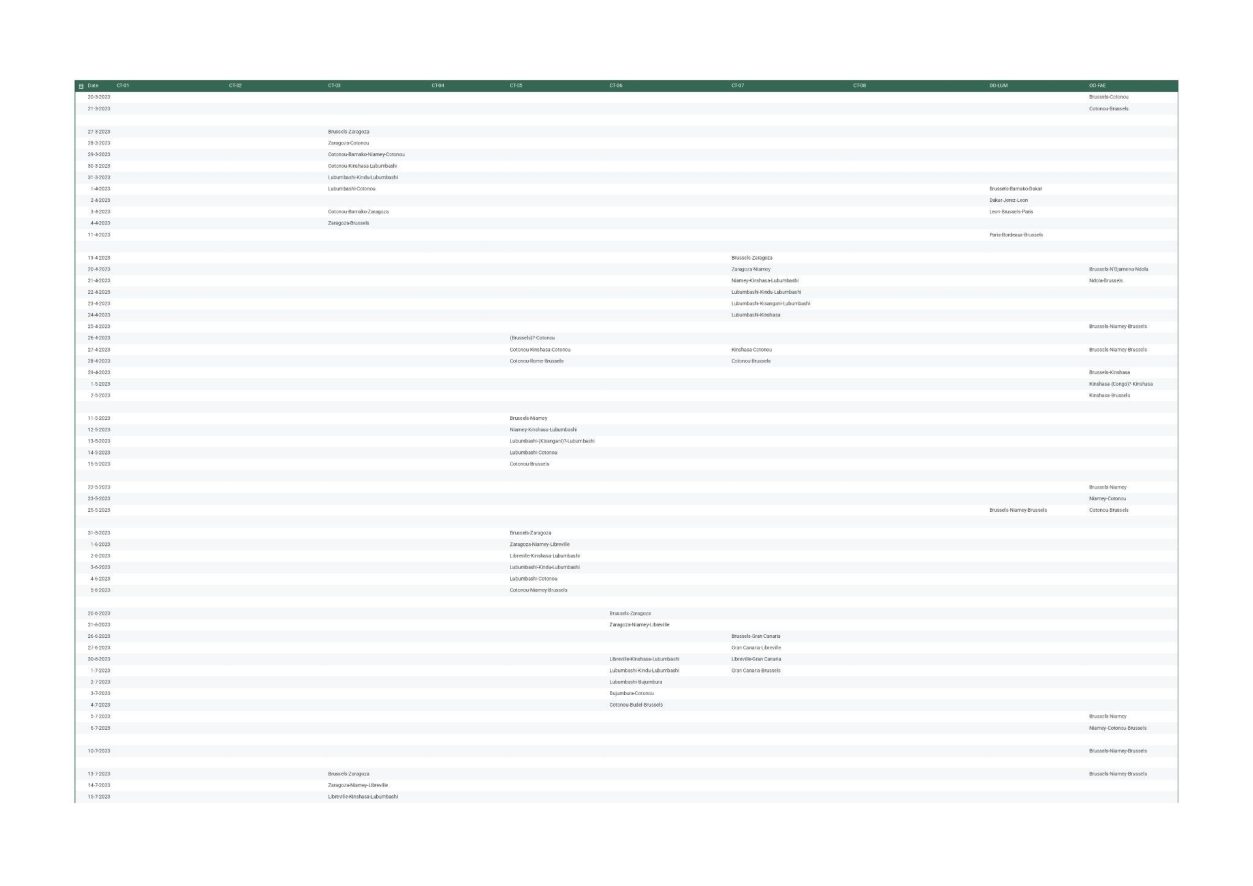
In this format, it is difficult to identify patterns and unusual activity across time and space, so the data was transformed into a GeoJSON with Claude Fable 5.0. First, a list of unique airports in the dataset and the corresponding coordinates was created. Then, using this list, the table was turned into a GeoJSON that recorded for each aircraft on which days it travelled and between which airports it travelled on those days. The data for CT-01 and CT-02 was manually checked and contained no errors. The chance that the conversion introduced errors for other aircraft seems unlikely. Furthermore, these errors would likely have quickly been noticed during the analysis, as they would most likely be unusual situations. No such situation was identified during the later analysis.
Using Claude Fable 5.0, a custom website was created that could easily display the GeoJSON and allow it to be filtered and analysed across time and space according to the needs of the investigation (Figure 8). It contains, among other things,
- settings to change how the dataset is displayed visually,
- options to filter the dataset by:
- flight route
- airport presence
- date
- a custom timeline that visualises the flights displayed on the map over their temporal properties,
- an export function that can be modified to exclude or include specific parts of the website,
- a chronological list of all flights.
The specific movements of individual flights can easily be examined by selecting them in the chronological list, the timeline, or on the map.
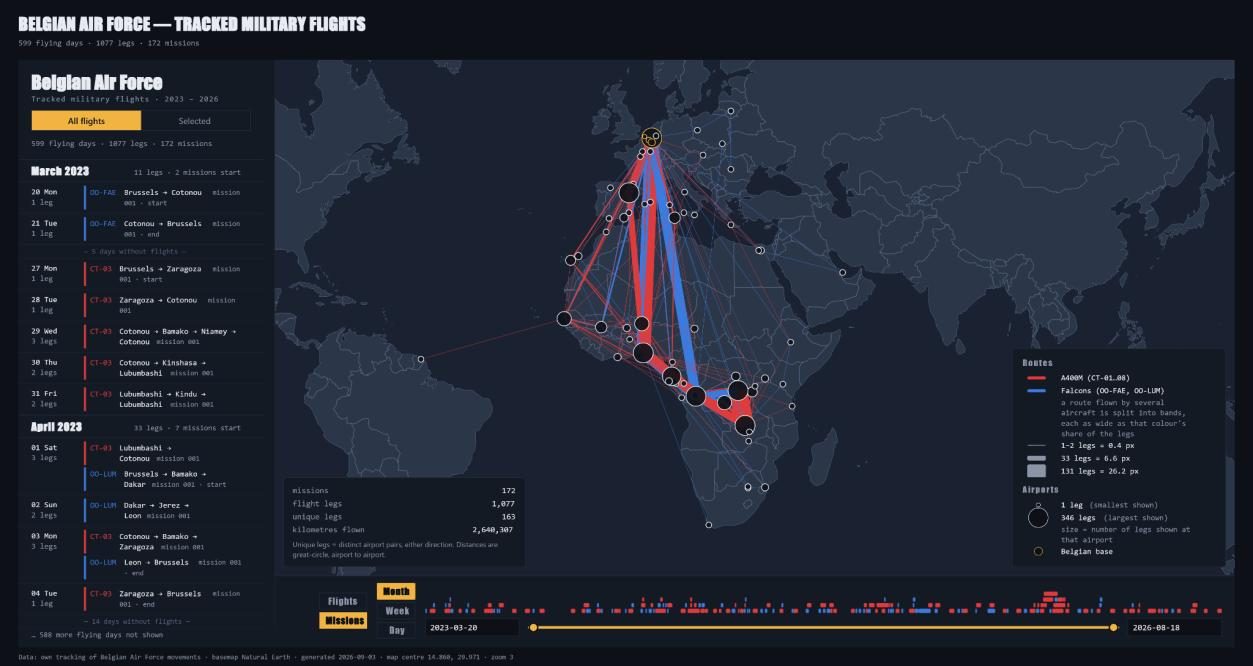
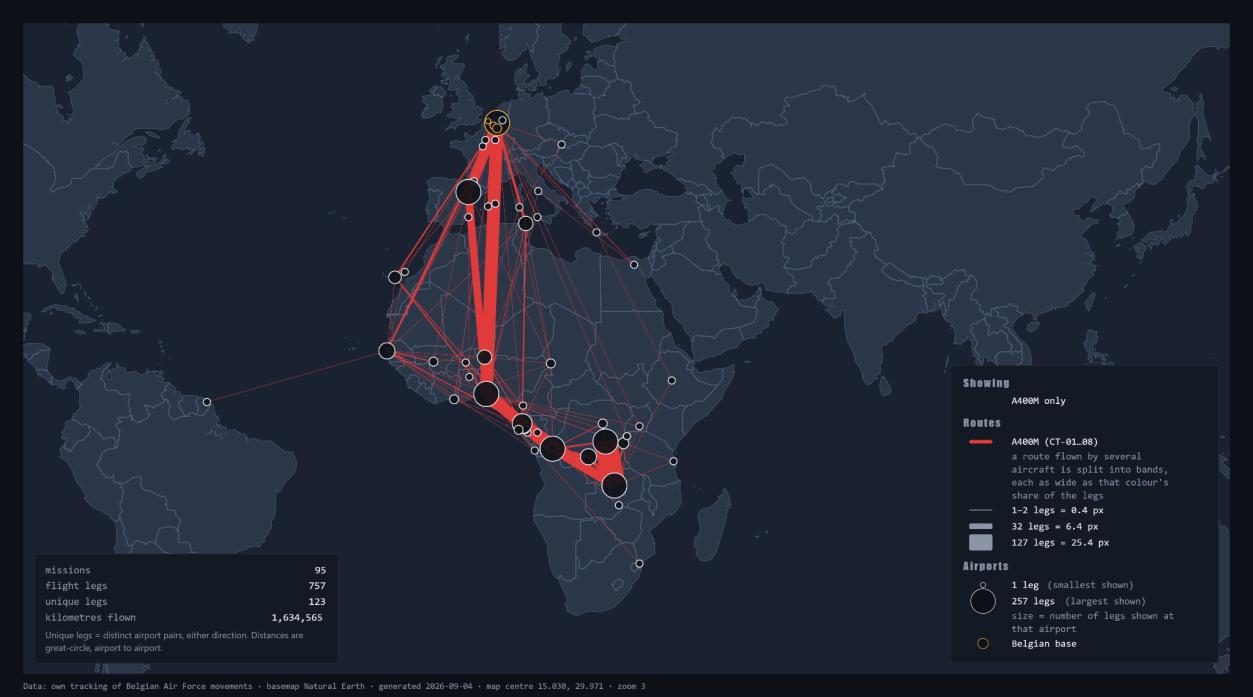
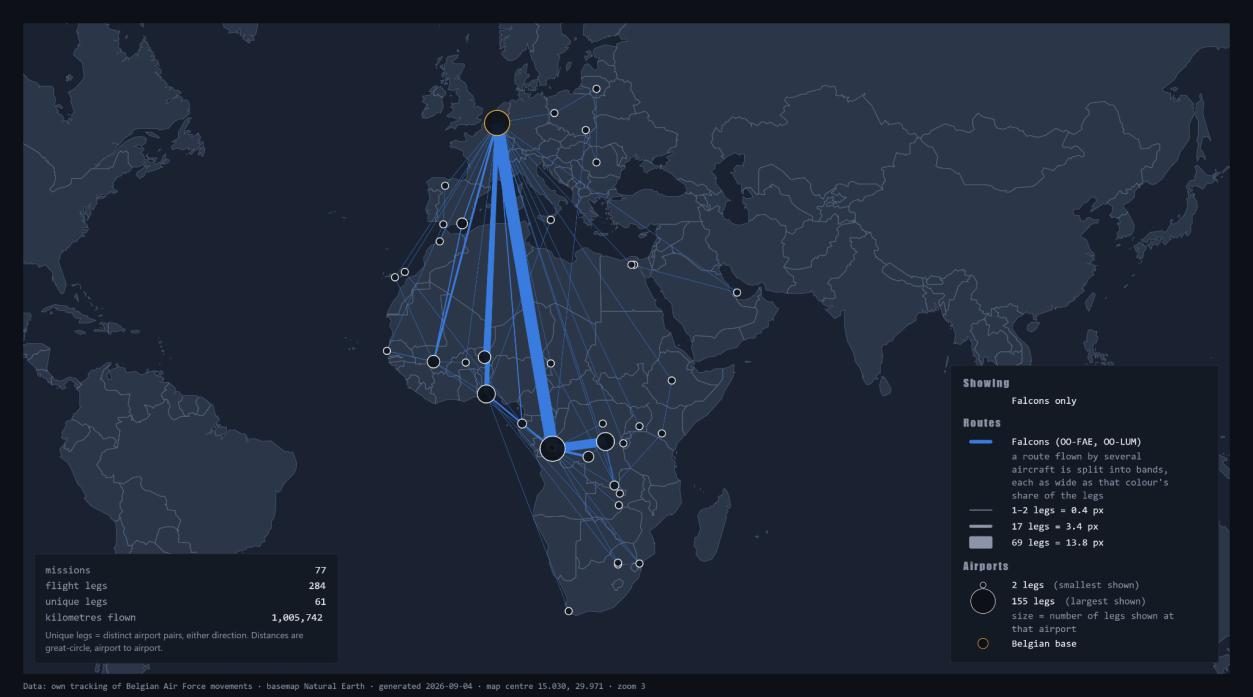
Overall, there were 95 A400M missions, with 791 airport to airport journeys (legs) spread across 123 unique routes. There were also 77 Falcon 7X missions, with 286 legs spread across 61 unique routes. This means that while there were a similar number of logistical missions as diplomatic missions, the total flight network is significantly smaller for the Falcon 7X. As can be seen on the map, the A400M has a wide network spanning several airports between Brussels and Central Africa (Figure 9). Meanwhile, the Falcon 7X is almost entirely focused around the Brussels–Kinshasa–Kindu line in the DRC, with a smaller amount going to Cotonou in Benin and Bamako in Mali (Figure 10).
2.2The Airports
To understand the movements that are visible in the database, it is important to understand the airports they are moving between. The visualised dataset does scale the airport symbol with the amount of times an aircraft visited it. However, for a deeper understanding, it is easier to begin with the statistics in table format. Therefore, I created an Excel sheet to list the amount of times an airport appeared in the dataset (Table 1). This sheet included several columns.
- The total amount of times an airport appeared in the dataset.
- The amount of times an aircraft departed from an airport.
- The amount of times an aircraft arrived at that airport.
- The amount of times an aircraft flew a local mission where it took off and subsequently landed at the same airport.
- The amount of unique missions that an airport appeared in.
The list roughly reflects what is shown by the airport symbol sizes on the dataset visualisation (Figures 9 and 10). Generally, the far majority of flights are going towards Central Africa. A large number also visit Zaragoza in Spain and Cotonou in Benin. A smaller number visits other West African airports such as Dakar, Niamey, Bamako, and Gran Canaria. After that, most other airports are visited a negligible amount of times.
From a statistical standpoint, the most unusual airports are Zaragoza and Libreville. Zaragoza because it has 56 missions, 58 departures, and 58 arrivals. This means that on average, each mission only visits it once. Most airports are visited more than once per mission, because they stop there both on the way to their furthest destination and on the way back from their furthest destination. Similarly, Libreville shows an extremely high number of Local sorties. Where most have 0, or maybe 1 or 2, Libreville has 31. Aside from that, most airports look normal at a first glance, except for the fact that some have been visited more often than others.
Table 1. Airport visitation statistics
| # | Airport | Country | Legs | Dep. | Arr. | Local | Missions |
|---|---|---|---|---|---|---|---|
| 1 | Brussels | Belgium | 348 | 174 | 174 | 0 | 172 |
| 2 | Kinshasa | DR Congo | 332 | 166 | 162 | 2 | 106 |
| 3 | Cotonou | Benin | 310 | 154 | 154 | 1 | 98 |
| 4 | Lubumbashi | DR Congo | 261 | 131 | 130 | 0 | 63 |
| 5 | Kindu | DR Congo | 192 | 95 | 97 | 0 | 76 |
| 6 | Libreville | Gabon | 138 | 38 | 38 | 31 | 25 |
| 7 | Zaragoza | Spain | 116 | 58 | 58 | 0 | 56 |
| 8 | Kananga | DR Congo | 58 | 29 | 29 | 0 | 23 |
| 9 | Dakar | Senegal | 53 | 25 | 28 | 0 | 18 |
| 10 | Niamey | Niger | 48 | 24 | 24 | 0 | 23 |
| 11 | Bamako | Mali | 34 | 17 | 17 | 0 | 15 |
| 12 | Tunis | Tunisia | 28 | 13 | 13 | 1 | 12 |
| 13 | Gran Canaria | Spain | 24 | 12 | 12 | 0 | 10 |
| 14 | Bujumbura | Burundi | 18 | 9 | 9 | 0 | 9 |
| 15 | Almeria | Spain | 12 | 6 | 6 | 0 | 6 |
| 16 | Kisangani | DR Congo | 12 | 6 | 6 | 0 | 5 |
| 17 | Abidjan | Côte d'Ivoire | 10 | 5 | 5 | 0 | 4 |
| 18 | N'Djamena | Chad | 10 | 5 | 5 | 0 | 5 |
| 19 | Port Gentil | Gabon | 10 | 5 | 5 | 0 | 2 |
| 20 | Ouagadougou | Burkina Faso | 8 | 4 | 4 | 0 | 3 |
| 21 | Brazzaville | Rep. Congo | 6 | 3 | 3 | 0 | 3 |
| 22 | Cairo | Egypt | 6 | 3 | 3 | 0 | 2 |
| 23 | Entebbe | Uganda | 6 | 3 | 3 | 0 | 3 |
| 24 | Florennes | Belgium | 6 | 3 | 3 | 0 | 3 |
| 25 | Koulamoutou | Gabon | 6 | 2 | 2 | 1 | 1 |
| 26 | Lanzarote | Spain | 6 | 3 | 3 | 0 | 3 |
| 27 | Maputo | Mozambique | 6 | 3 | 3 | 0 | 3 |
| 28 | Lambarene | Gabon | 5 | 2 | 3 | 0 | 2 |
| 29 | Addis Ababa | Ethiopia | 4 | 2 | 2 | 0 | 2 |
| 30 | Beauvechain | Belgium | 4 | 2 | 2 | 0 | 2 |
| 31 | Budel | Netherlands | 4 | 2 | 2 | 0 | 2 |
| 32 | Giza | Egypt | 4 | 2 | 2 | 0 | 1 |
| 33 | Kigali | Rwanda | 4 | 2 | 2 | 0 | 2 |
| 34 | Lusaka | Zambia | 4 | 2 | 2 | 0 | 2 |
| 35 | Paris | France | 4 | 2 | 2 | 0 | 1 |
| 36 | Pointe Noire | Rep. Congo | 4 | 2 | 2 | 0 | 2 |
| 37 | Rome | Italy | 4 | 2 | 2 | 0 | 2 |
| 38 | Tamale | Ghana | 4 | 2 | 2 | 0 | 2 |
| 39 | Vatry | France | 4 | 2 | 2 | 0 | 1 |
| 40 | Bratislava | Slovakia | 2 | 1 | 1 | 0 | 1 |
| 41 | Cape Town | South Africa | 2 | 1 | 1 | 0 | 1 |
| 42 | Catania | Italy | 2 | 1 | 1 | 0 | 1 |
| 43 | Cayenne | French Guiana | 2 | 1 | 1 | 0 | 1 |
| 44 | Chania | Greece | 2 | 1 | 1 | 0 | 1 |
| 45 | Chievres | Belgium | 2 | 1 | 1 | 0 | 1 |
| 46 | Dar Es Salaam | Tanzania | 2 | 1 | 1 | 0 | 1 |
| 47 | Decimomannu | Italy | 2 | 1 | 1 | 0 | 1 |
| 48 | Doha | Qatar | 2 | 1 | 1 | 0 | 1 |
| 49 | Douala | Cameroon | 2 | 1 | 1 | 0 | 1 |
| 50 | Fougamou | Gabon | 2 | 1 | 1 | 0 | 1 |
| 51 | Jerez | Spain | 2 | 1 | 1 | 0 | 1 |
| 52 | Johannesburg | South Africa | 2 | 1 | 1 | 0 | 1 |
| 53 | Kaunas | Lithuania | 2 | 1 | 1 | 0 | 1 |
| 54 | Leon | Spain | 2 | 1 | 1 | 0 | 1 |
| 55 | Mahon | Spain | 2 | 1 | 1 | 0 | 1 |
| 56 | Murcia | Spain | 2 | 1 | 1 | 0 | 1 |
| 57 | Nairobi | Kenya | 2 | 1 | 1 | 0 | 1 |
| 58 | Ndola | Zambia | 2 | 1 | 1 | 0 | 1 |
| 59 | Orleans | France | 2 | 1 | 1 | 0 | 1 |
| 60 | Ostend | Belgium | 2 | 1 | 1 | 0 | 1 |
| 61 | Palma de Mallorca | Spain | 2 | 1 | 1 | 0 | 1 |
| 62 | Pretoria | South Africa | 2 | 1 | 1 | 0 | 1 |
| 63 | Rabat | Morocco | 2 | 1 | 1 | 0 | 1 |
| 64 | Rzeszow | Poland | 2 | 1 | 1 | 0 | 1 |
| 65 | Sibiu | Romania | 2 | 1 | 1 | 0 | 1 |
| 66 | Tarbes | France | 2 | 1 | 1 | 0 | 1 |
| 67 | Trapani | Italy | 2 | 1 | 1 | 0 | 1 |
| 68 | Zielona Gora | Poland | 2 | 1 | 1 | 0 | 1 |
Swipe sideways to see all columns.
To get a slightly better understanding of how the airports are used, it is possible to separate the A400M flights from the Falcon 7X flights. We know that the Falcon 7X forms a much smaller network of flights than the A400M. Theoretically, that means they might also visit airports at different frequencies. Table 2 shows the number of legs and unique missions for the top 15 most visited airports for the A400M, whereas Table 3 shows it for the Falcon 7X.
Table 2. A400M airport visitation statistics (top 15)
| # | Airport | Country | Legs | Missions |
|---|---|---|---|---|
| 1 | Cotonou | Benin | 260 | 76 |
| 2 | Lubumbashi | DR Congo | 253 | 59 |
| 3 | Brussels | Belgium | 192 | 95 |
| 4 | Kinshasa | DR Congo | 172 | 63 |
| 5 | Kindu | DR Congo | 136 | 51 |
| 6 | Zaragoza | Spain | 116 | 56 |
| 7 | Libreville | Gabon | 99 | 21 |
| 8 | Dakar | Senegal | 49 | 16 |
| 9 | Kananga | DR Congo | 42 | 16 |
| 10 | Niamey | Niger | 28 | 13 |
| 11 | Tunis | Tunisia | 27 | 12 |
| 12 | Gran Canaria | Spain | 22 | 9 |
| 13 | Bujumbura | Burundi | 14 | 7 |
| 14 | Abidjan | Côte d'Ivoire | 10 | 4 |
| 15 | Bamako | Mali | 10 | 4 |
Table 3. Falcon 7X airport visitation statistics (top 15)
| # | Airport | Country | Legs | Missions |
|---|---|---|---|---|
| 1 | Kinshasa | DR Congo | 158 | 43 |
| 2 | Brussels | Belgium | 156 | 77 |
| 3 | Kindu | DR Congo | 56 | 25 |
| 4 | Cotonou | Benin | 49 | 22 |
| 5 | Bamako | Mali | 24 | 11 |
| 6 | Niamey | Niger | 20 | 10 |
| 7 | Kananga | DR Congo | 16 | 7 |
| 8 | Almeria | Spain | 12 | 6 |
| 9 | Libreville | Gabon | 8 | 4 |
| 10 | Lubumbashi | DR Congo | 8 | 4 |
| 11 | Bujumbura | Burundi | 4 | 2 |
| 12 | Dakar | Senegal | 4 | 2 |
| 13 | Maputo | Mozambique | 4 | 2 |
| 14 | Giza | Egypt | 4 | 1 |
| 15 | Ouagadougou | Burkina Faso | 4 | 1 |
2.3The Patterns
As we could see in Figures 9 and 10, several airports that are regularly visited by the A400M are entirely sidestepped by the Falcon 7X. Airports such as Zaragoza, Tunis, and Gran Canaria belong almost exclusively to the logistical network. Conversely, Almeria belongs exclusively to the diplomatic network. Other airports seem to be relatively more important in one network than the other, but are a part of both.
Notably, Zaragoza airport has been linked to the sale and transport of over 60,000 weapons parts from Spain to Israel between January and November 2024.22
Simply knowing the shape and statistics of the overall flight network is not enough. To start identifying suspicious flights, we need to know why the network has certain properties. How, and with what frequency, are the airports connected to each other. Why are specific airports more or less connected. When this is clear, the patterns become easier to understand. In this case, the Falcon 7X flights will be termed “diplomatic” flights and the A400M flights will be termed “logistical” flights. These terms are selected due to the theoretical purpose of the two types of aircraft. In reality, either of them can perform both functions.
2.3.1 Diplomatic
Notably, the Falcon 7X has a large enough range to reach any destination in Africa from Brussels without stopping to refuel (Figure 11). This means that, in theory, every stop has an explanation beyond fuel requirements. As previously noted, the majority of flights go to Kinshasa and Kindu.
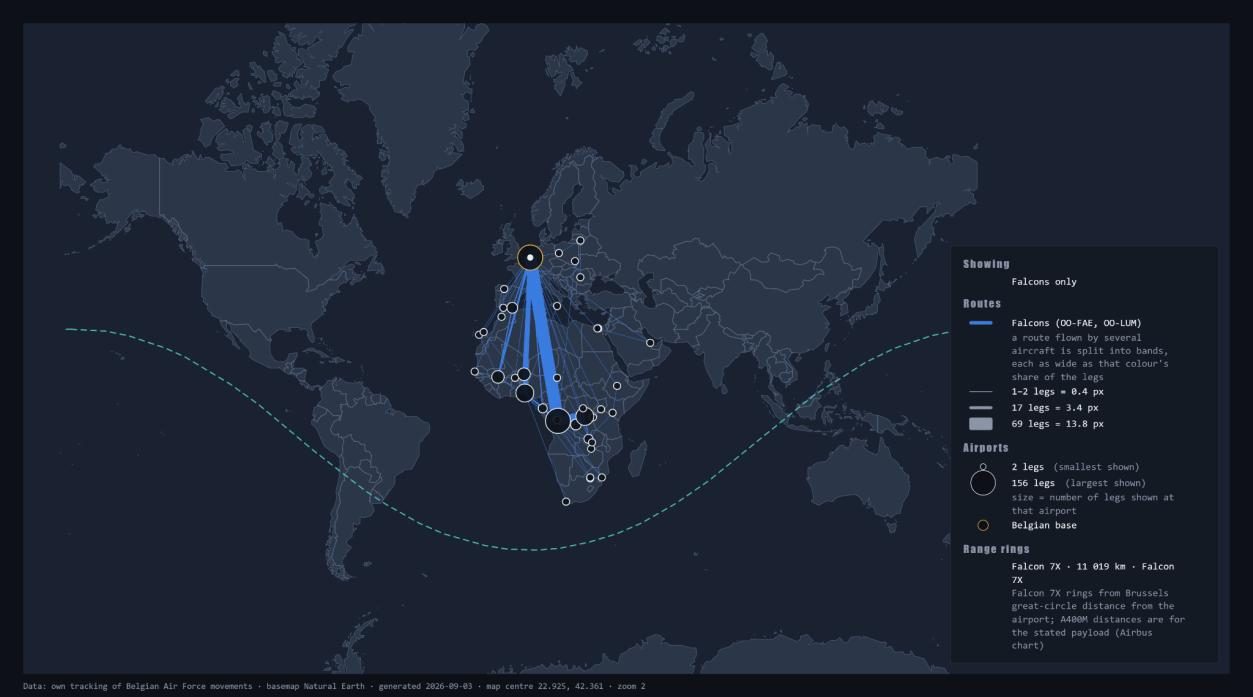
Figure 12 shows all Falcon 7X flights that included a stop in the DRC. Clearly, the majority goes straight to Kinshasa and usually continues on to Kindu. Some make a stop in Cotonou before continuing on to Kinshasa. On rare occasions they also make stops in other parts of Africa. Meanwhile, Figure 13 shows the network of flights that do not involve the DRC. Cotonou features heavily in both, showing how it is used both as a stop on the way to Central and Southern Africa, but also as a diplomatic destination in itself. Several new airports have appeared in Western Africa and Egypt, showing how these destinations are diplomatically considered separate from the DRC. Bamako in Mali and Niamey in Niger feature as particularly prominent destinations.
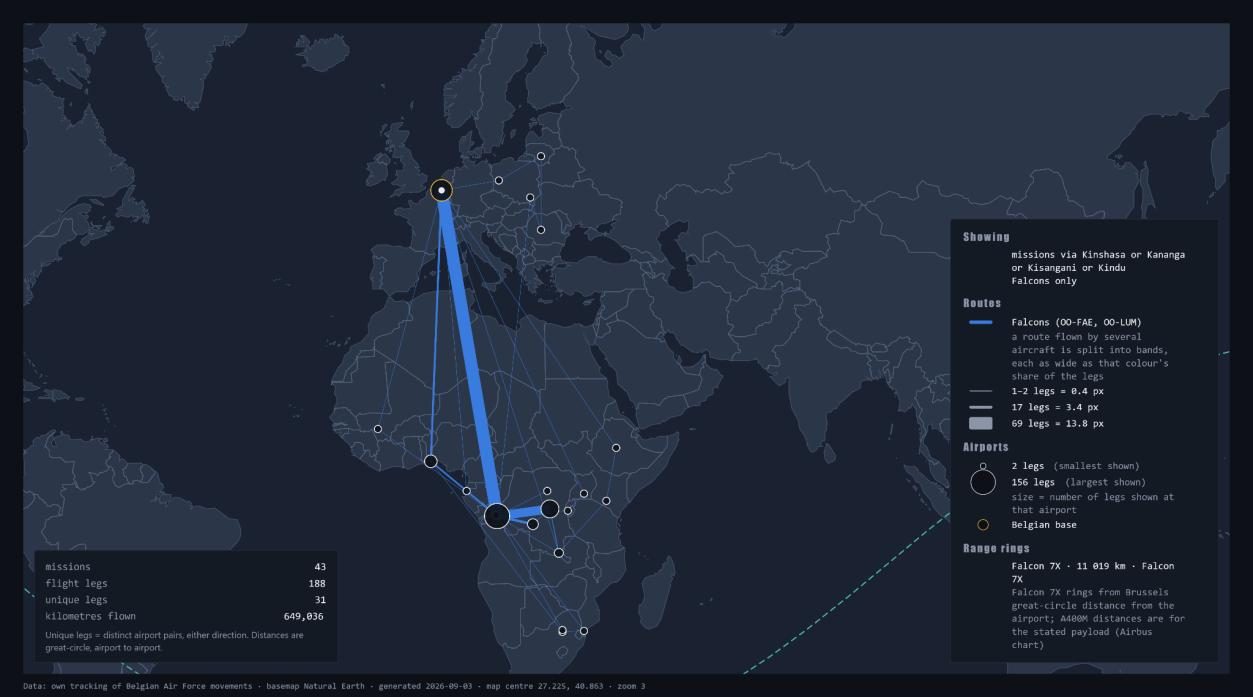
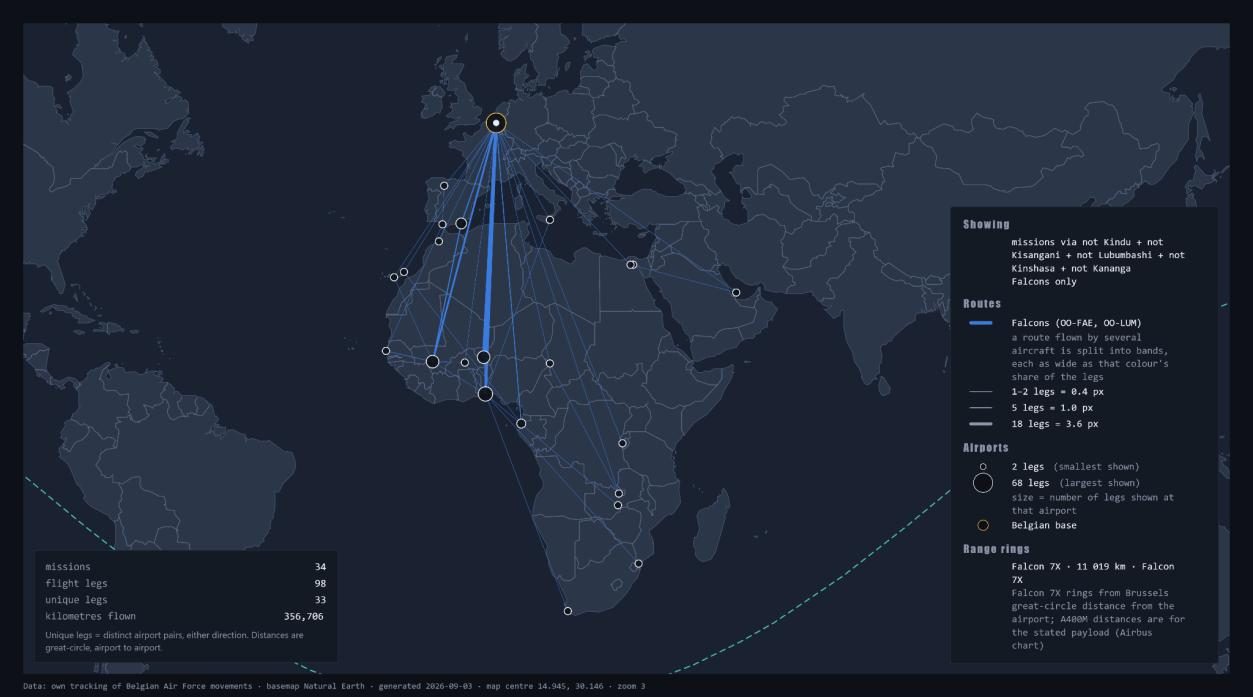
Overall, DRC-related missions are responsible for 26.47% more missions than non-DRC-related missions in Africa. At the same time, the DRC-related network contains 6% fewer unique legs but sees 91.84% more legs. This is largely because the non-DRC network consists primarily of flights that go from Brussels to a destination and back. Meanwhile, the DRC network is dominated by flights that go from Brussels to Kinshasa to Kindu. This means that rather than most flights consisting of 2 legs, they have 4 legs.
Regular patterns for diplomatic flights thus include:
- DRC
- Brussels (– Cotonou) – Kinshasa – Kindu – Kinshasa – Brussels
- West Africa
- Brussels – Cotonou
- Brussels – Niamey
- Brussels – Bamako
Each of these patterns also has a temporal element. Since we are focused on DRC-related allegations, Figure 14 shows the number of missions and the flights within these missions over time for the DRC network. These flights have been ongoing since the start of the dataset, although they have only become regular since December 2023.

2.3.2 Logistics
The A400M network contains more than double the number of unique legs compared to the Falcon 7X network. While the network is larger, that does not mean there are more patterns. As seen in Figure 9, the vast majority of flights are still going to the DRC. They just make more stops on the way. To better visualise the difference, Figure 15 shows the missions that include a stop in the DRC whereas Figure 16 shows the missions that do not include a stop in the DRC.
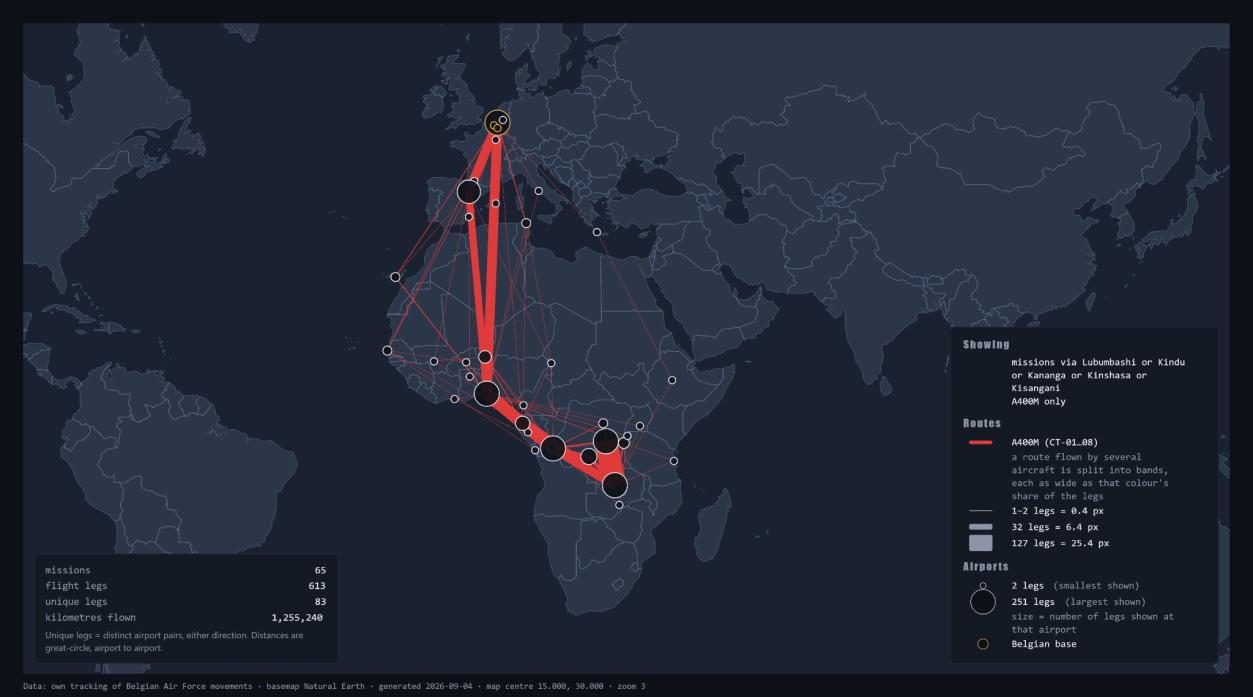
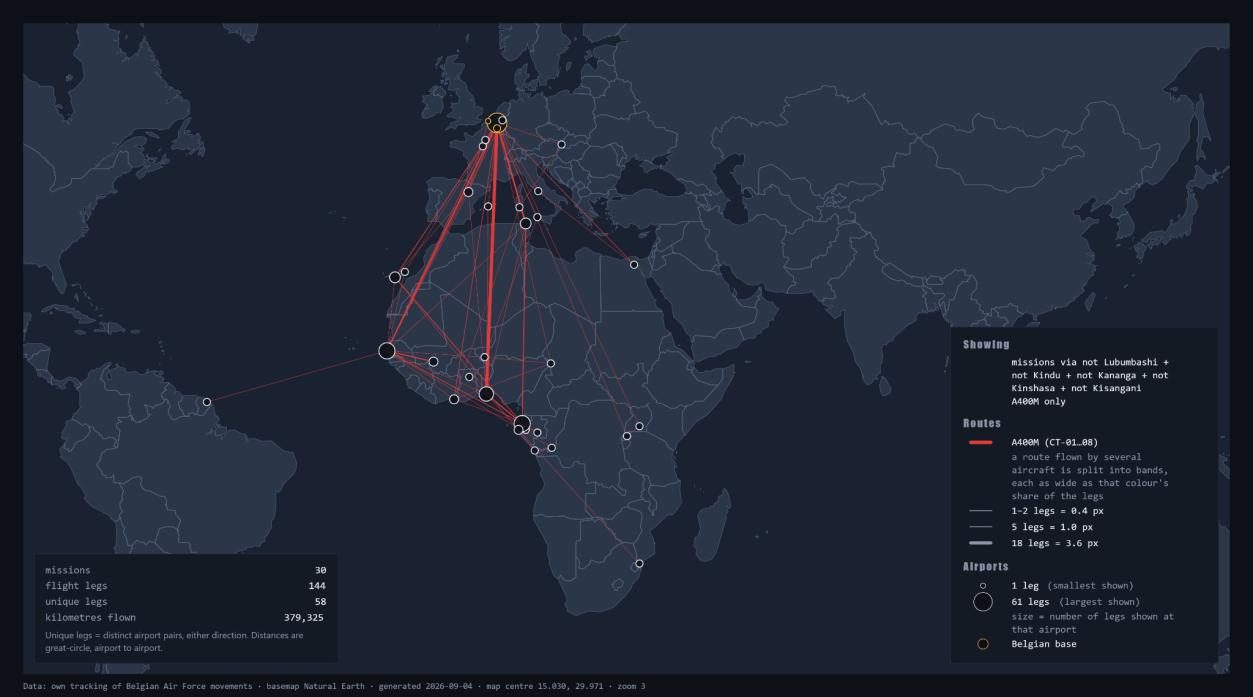
The timeline shown in Figure 17 can be used to better understand the non-DRC network. During November and December 2025, there is a large spike in concurrent missions with a significant number of flights. This is due to a large military exercise called “Tropical Storm” which was held in Gabon. All logistics and aerial exercises went through Libreville. This also explains the large number of Local sorties in Table 1.

Excluding Libreville, the network becomes what is visible in Figure 18. As with the Diplomatic network, there is a significant number of flights going from Brussels to Cotonou. Aside from that, there are a significant number of flights going to Dakar, which often continue on to other airports in the region.
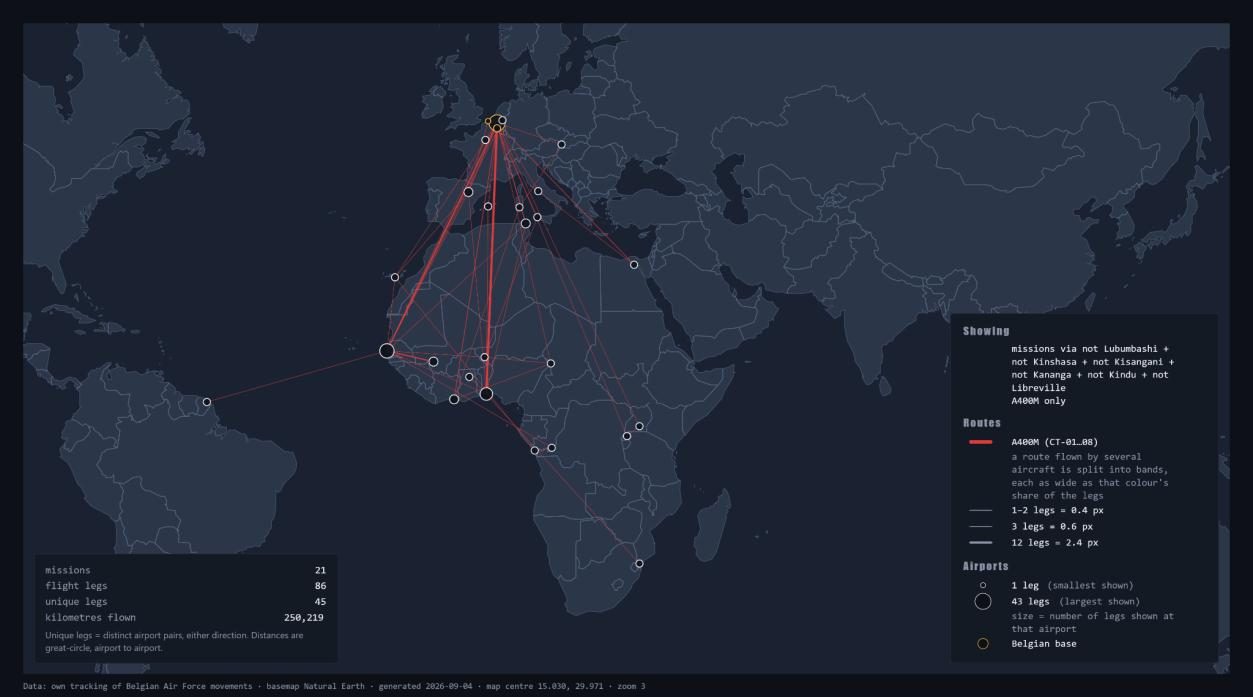
Overall, the DRC-related network is responsible for 116.67% more missions than the non-DRC-related network. Furthermore, 30% of all non-DRC-related missions over the past 3 years were due to a single series of exercises in November and December 2025. On top of that, the DRC-related network sees 244.38% more legs than the non-DRC-related network. Removing the local sorties from the military exercises, to prioritise logistics-related legs, this number jumps to 325.69%. However, the DRC-related network is also larger, consisting of 43.1% more unique legs. Although it should be noted that the far majority of these legs are from only a small number of those unique legs.
Regular patterns for A400M flights thus include:
- DRC
- Brussels – Zaragoza – Cotonou – Kinshasa – Lubumbashi – Kindu – Lubumbashi – Cotonou – Brussels
- Tropical Storm
- Brussels – Gran Canaria/Lanzarote – (Dakar) – Libreville – (Dakar) – Gran Canaria/Lanzarote – Brussels
- Brussels – Tunis/Cotonou – Libreville – Cotonou/Tunis – Brussels
- West Africa
- Brussels – (Zaragoza/Gran Canaria/Tunis) – Dakar – ? – Dakar – Brussels
- Brussels – Cotonou – Brussels
In these patterns, one common theme is that there are a lot of airports while en route to the furthest destination, but the return journey is often a lot shorter. Furthermore, in certain cases, as with Tropical Storm and West African flights, these first few stops are not often the same. However, all alternatives that you see on a certain pattern tend to be within a similar distance from Brussels. When fully loaded, the A400M’s range is significantly shorter than that of a Falcon 7X. Figures 19–22 show the range of the A400M at different common payload levels from the airports of Brussels, Zaragoza, Cotonou, and Kinshasa.
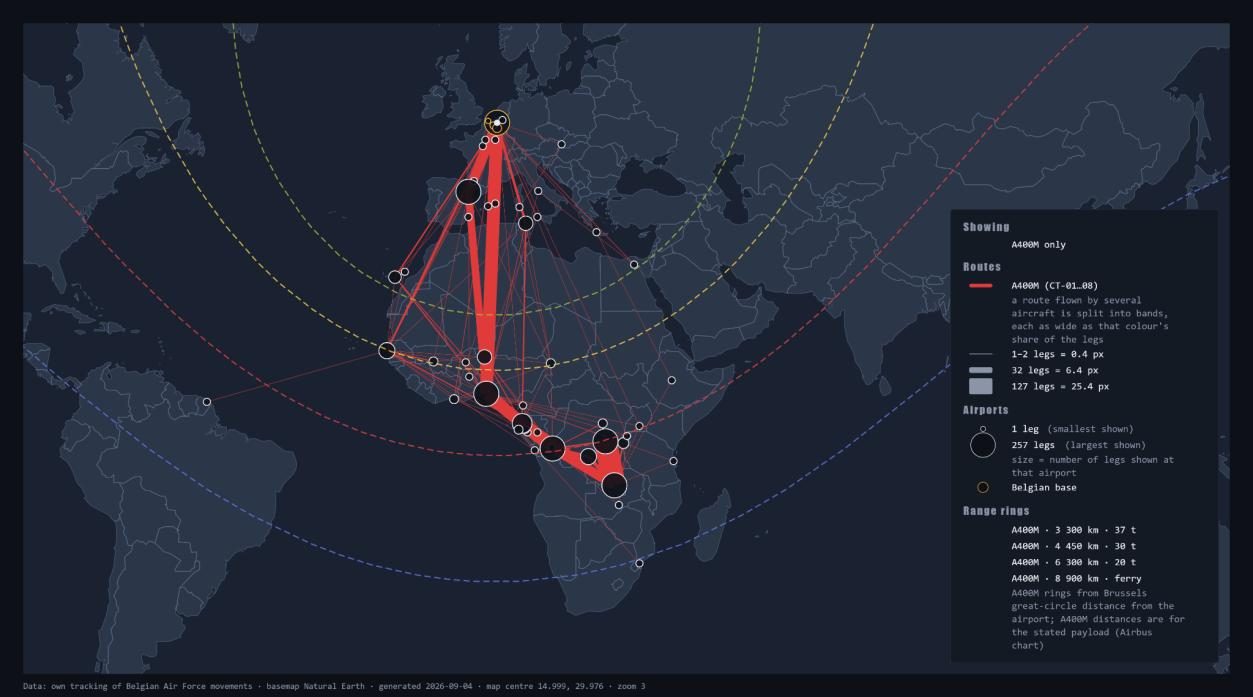
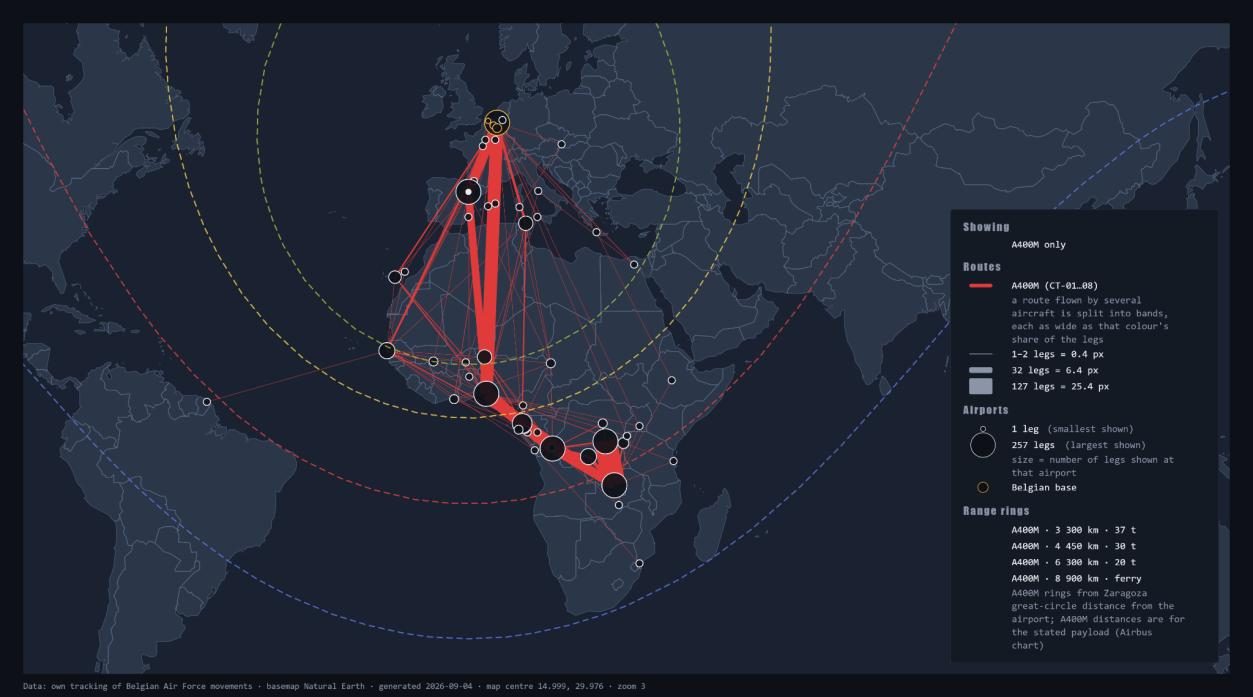
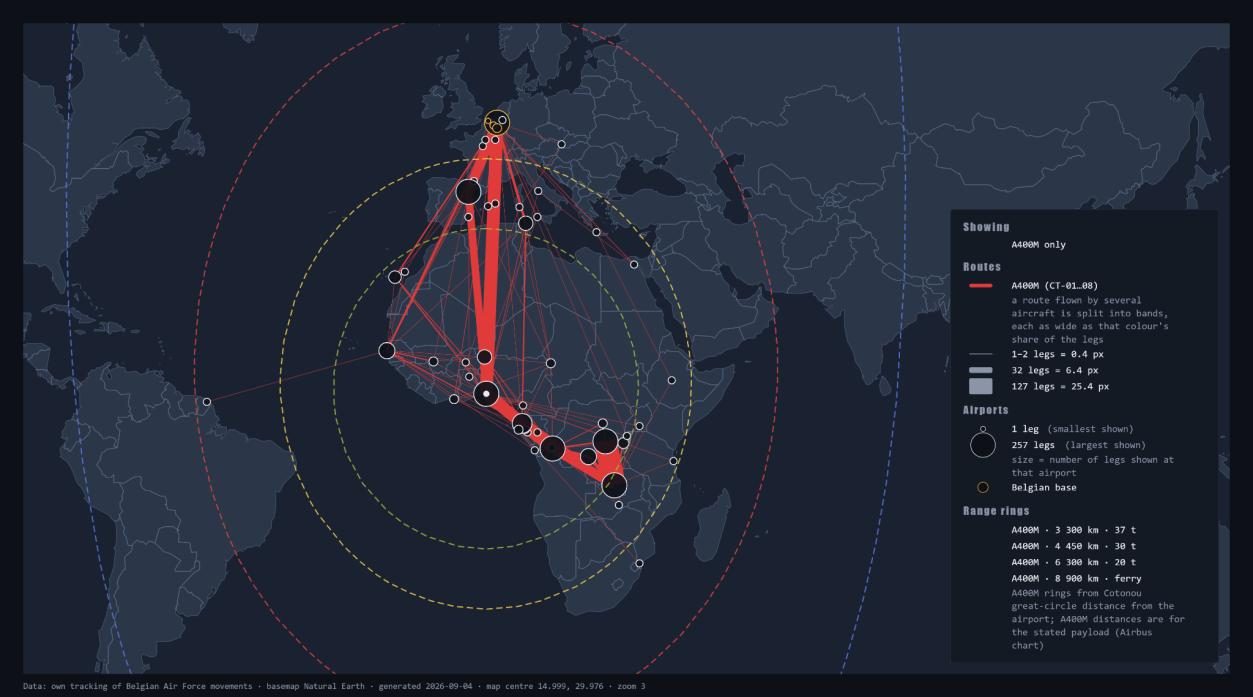
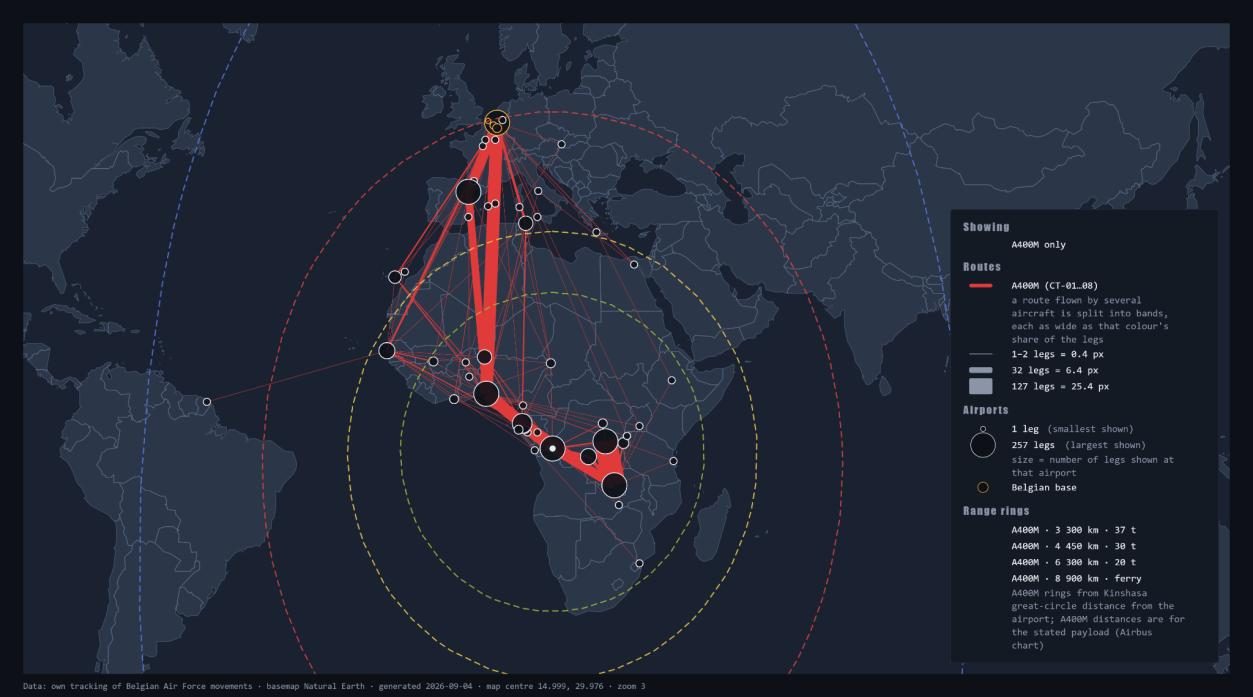
From Brussels, an A400M with a 30 ton payload will not be able to reach Cotonou. However, after refuelling in Zaragoza, it can reach Cotonou, before continuing to the DRC. If it offloads enough of its cargo in the DRC, it can suddenly skip the stop in Zaragoza and reach Brussels in 1 go. With enough unloaded cargo, it might even be able to reach the DRC from Central Africa. However, for one of a series of potential reasons, they almost always fly back through Cotonou.
For Tropical Storm, it can be assumed that some of the planes were at their heaviest. This may explain why they bypassed Zaragoza for Gran Canaria. Gran Canaria is just within the limit of their max payload range from Brussels. From Gran Canaria, Cotonou is just within the limit of their max payload range. In other words, this was the only potential route a maximally loaded A400M could have taken to reach Libreville.
The same logistics logic applies to the West African patterns.
The temporal element of the DRC network is surprisingly stable. Generally, there is a flight roughly every 2–3 weeks (Figure 23).

When looking specifically at Kindu, where the Belgian mission would need to be resupplied, the pattern, for the most part, remains just as stable (Figure 24).

2.4The Irregularities
Nevertheless, several major irregularities do appear. These will be addressed per allegation.
- Belgium is using the Zaragoza airbase as a logistics hub for military shipments.
No specific irregularities can be found at the Zaragoza airbase beyond what has been described in section 2.2 about the airbase’s context. Section 2.3.2 clearly shows why many aircraft might need to make an extra stop in Spain to refuel in order to reach the next friendly airbase. While questions can be asked about why this specific airbase is used, it may be because Zaragoza is relatively close to a direct path from Brussels to Cotonou, saving time and fuel.
- Belgium sent tanks to fight in the DRC.
- Belgium sent military equipment to the DRC.
- Including the transport of five CH-4 drones from Kinshasa to Bujumbura via Kalemie on May 2nd, 2025.
- Belgium sent 300–400 troops to fight in the DRC.
- At least 8 of those soldiers have been killed, including one called Jimmy Luis Flanders.
Claims 2, 3, and 4 were based on a supposed series of flights in March 2025. These flights appear in the database and do appear highly irregular. In terms of A400M flights, Kindu has received 51 missions and 136 legs, 68 landing + takeoff combinations. This means that most missions land at Kindu, pick up or deliver what cargo they are responsible for, and return to Brussels. As seen in Figure 24, there is almost never more than 1 A400M in Kindu at a time.
Both of these patterns have been broken a single time in the past 3 years. Between February 27th, and March 10th, 2025, CT-07 made 10 flights to Kindu in a single mission. More than that, after its first landing in Kindu, it went back to Cotonou for a day before returning back to the DRC and performing the rest of its missions. It also made a stop in Kananga on February 28th, 2025. Furthermore, in another pattern breaking action, CT-02 also landed in Kindu on March 7th, 2025. Meaning that there were 2 A400M aircraft operating on the Lubumbashi–Kindu route simultaneously (Figure 25).
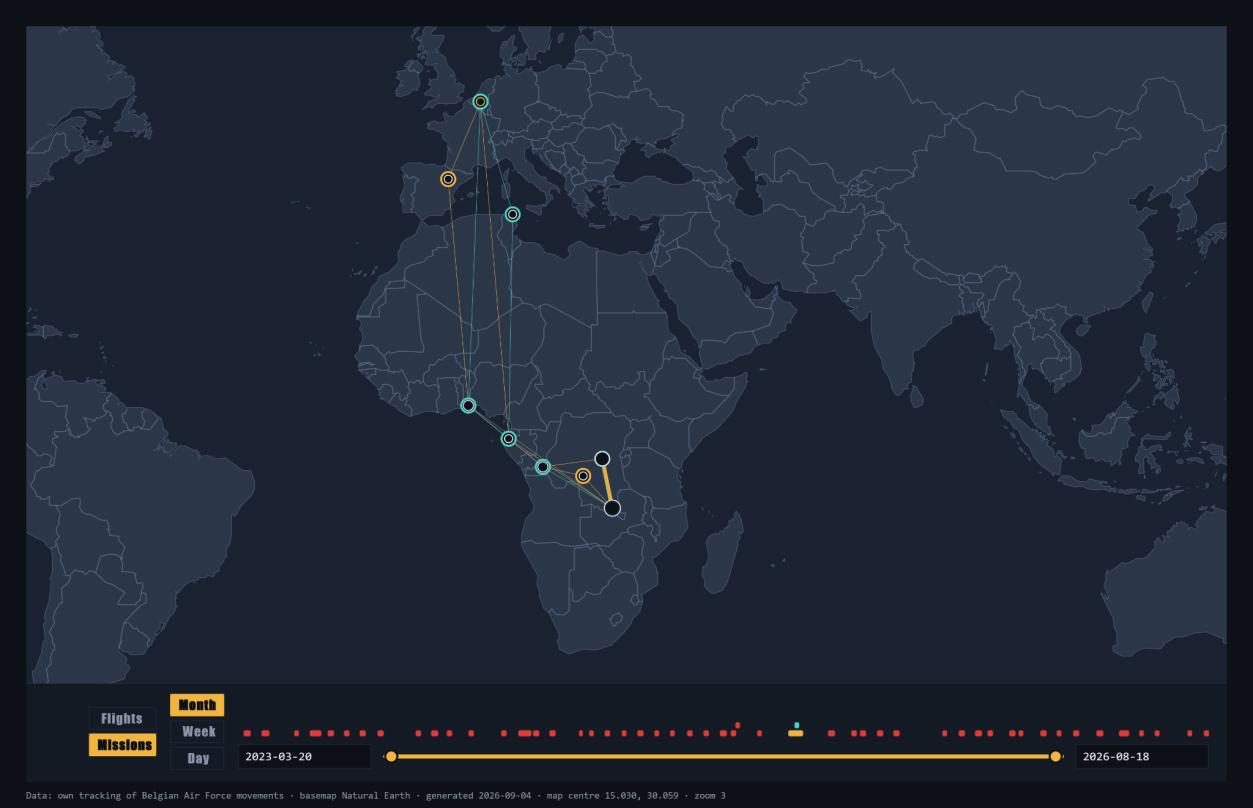
However, it is clear that Belgium did not transport these CH-4 drones by air on May 2nd, as at the time there were no Belgian A400M planes in Africa.
- Belgium uses Burundi as base for military logistics.
- Belgium has had covert talks with Burundi military officials.
The only known flights by the Belgian Air Force that include Burundi around this time period are:
Diplomatic:
- 21–22 March, 2025. Unknown.
- 25–30 April, 2025. Maxime Prévot, state visit.
Military:
- 16–22 May, 2025. Unknown.
- 22–30 October, 2025. Unknown.
- 27 March – 4 April, 2026. Unknown.
Belgian A400Ms have been landing twice per year in Burundi since the start of the database (Figure 26), so it is not irregular, but there is also not enough information to establish a clear pattern for context.

The Falcon 7X flight in March is more irregular, as the reason is not publicly known. It may have been to help organise the later state visit. But it may also have been related to something else.
A follow up analysis on these dates on social media did not yield any evidence.
2.5The Evidence
In an attempt to identify the cargo that was on the planes, an Excel sheet was created that listed all airports with the dates that an aircraft was visiting. An excerpt of that table is shown in Table 4. The listed dates were compared with publicly available sources of high resolution satellite imagery for each airport. In theory, the cargo might have been visible next to a parked plane. However, no imagery was available on the right time and date to show one of the planes or potential cargo on the tarmac.
However, as mentioned before, that does not mean that there is no evidence. It simply means that I did not have the ability to locate any evidence if it does exist.
Table 4. Excerpt from the Excel sheet tracking all relevant airbases in Africa and the dates during which a Belgian Air Force aircraft was present
| Airport / city | Visit dates | Lat. | Long. |
|---|---|---|---|
| Bujumbura | 2-7-2023, 3-7-2023, 6-11-2023, … | −3.3212 | 29.3193 |
| Florennes | 25-4-2023, 19-1-2024, 30-4-2024 | 50.2351 | 4.6453 |
| Kananga | 28-11-2023, 30-11-2023, 15-1-2024, … | −5.9013 | 22.4772 |
| Kigali | 20-8-2024, 18-3-2025, 19-3-2025 | −1.9643 | 30.1349 |
| Kindu | 31-3-2023, 22-4-2023, 3-6-2023, … | −2.9264 | 25.9159 |
| Kinshasa | 30-3-2023, 21-4-2023, 24-4-2023, … | −4.3903 | 15.4417 |
| Kisangani | 23-4-2023, 13-5-2023, 6-2-2024, … | 0.4911 | 25.3294 |
| Lubumbashi | 30-3-2023, 31-3-2023, 1-4-2023, … | −11.5893 | 27.5314 |
| Zaragoza | 27-3-2023, 28-3-2023, 3-4-2023, … | 41.6661 | −1.0417 |
| Brussels | 20-3-2023, 21-3-2023, 27-3-2023, … | 50.9134 | 4.4910 |
| Budel | 4-7-2023, 22-6-2024 | 51.2581 | 5.5970 |
| Cotonou | 20-3-2023, 21-3-2023, 28-3-2023, … | 6.3529 | 2.3826 |
| Entebbe | 19-3-2025, 21-3-2025, 25-4-2025, … | 0.0453 | 32.4417 |
| Gran Canaria | 26-6-2023, 27-6-2023, 30-6-2023, … | 27.9321 | −15.3885 |
| Cairo | 8-5-2024, 9-5-2024, 10-5-2024, … | 30.1178 | 31.4077 |
| Dakar | 1-4-2023, 2-4-2023, 3-8-2023, … | 14.6705 | −17.0719 |
| Dar Es Salaam | 10-11-2024, 11-11-2024 | −6.8687 | 39.2086 |
| Lanzarote | 22-11-2025, 26-11-2025, 16-12-2025, … | 28.9503 | −13.6056 |
| Almeria | 2-12-2023, 3-12-2023, 27-1-2024, … | 36.8448 | −2.3722 |
Chapter 3Conclusions
This research set out to investigate the following allegations:
- Belgium is using the Zaragoza airbase as a logistics hub for military shipments.
- Belgium sent tanks to fight in the DRC.
- Belgium sent military equipment to the DRC.
- Including the transport of five CH-4 drones from Kinshasa to Bujumbura via Kalemie on May 2nd, 2025.
- Belgium sent 300–400 troops to fight in the DRC.
- At least 8 of those soldiers have been killed, including one called Jimmy Luis Flanders.
- Belgium uses Burundi as base for military logistics.
- Belgium has had covert talks with Burundi military officials.
For the first allegation, while the Zaragoza airbase has been linked to weapons shipments in other cases, it is most likely used as a place to refuel before heading to Cotonou. Nevertheless, in theory, the Belgian Air Force could have used different airbases. While the allegation may be true, based on the available information, the allegation seems very unlikely.
For the second allegation, there is no reason to believe that Belgium sent tanks to fight in the DRC. Belgium does not produce any tanks, no NATO tanks have appeared in the DRC, nor would an A400M have been able to effectively transport tanks into the DRC with the amount of flights they performed.
For allegations 3, 3a, 4, and 4a, there is no reason to believe that Belgium transported these CH-4 drones or that at least 8 Belgian soldiers have been killed. However, the unusual activity of CT-07 between February 27th and March 10th, in combination with the presence of CT-02, does indicate that there may have been some form of covert activity. To properly dispel these rumours, some evidence would need to be provided about what they were transporting.
For allegations 5 and 6, there is no way to prove it. However, the regular presence of A400M aircraft, without a clear argument behind why they should be there, does raise questions.
In conclusion, there is no reason to believe that any of the allegations are true. However, the reasoning behind some of the allegations is understandable. Particularly claims 3, 5, and 6. Nevertheless, these allegations should be easy to dispel if the aircraft in question were not carrying military aid and the proper documentation of the cargo still exists.
NotesNotes
- Daniel Gatimu, “Understanding Belgium’s Rejection of Rwanda’s Envoy, and Brussels’ Reckoning with Its Colonial Past,” Great Lakes Eye, October 2, 2023. source ↩
- Gatimu. ↩
- Emma Mukasa, “Belgium Deploys Troops to Eastern DRC,” Great Lakes Eye, March 24, 2025. source ↩
- Yousuf Rwaka, “Belgium Using NATO Facilities to Worsen Eastern DRC Conflict,” Great Lakes Eye, November 13, 2025. source ↩
- Jones Mila, “Belgium’s Denial of Troop Deployment to DRC Debunked,” Great Lakes Eye, April 3, 2025. source ↩
- Mila. ↩
- Josephine Kalembe, “Belgium Actively Participating in DRC War,” Great Lakes Eye, May 7, 2025. source ↩
- Kalembe. ↩
- Yousuf Rwaka, “DRC: Belgium Manning Drone Strikes Targeting Banyamulenge,” Great Lakes Eye, September 9, 2025. source ↩
- Daniel Gatimu, “Belgium Uses Burundi as Regional Military Base for DRC Conflict,” Great Lakes Eye, December 1, 2025. source ↩
- Samson Kasujja, “Belgium, Burundi Increase Attacks on AFC/M23 despite Peace Talks,” Great Lakes Eye, May 29, 2025; Jones Mila, “Eastern DRC Crisis: Belgium Talks Peace, Covertly Intervenes Militarily,” Great Lakes Eye, August 8, 2025. source ↩
- Maxime Prévot, “X post denying reports of a Belgian troop deployment to the DRC,” X (@prevotmaxime), March 26, 2025. source ↩
- Maxime Prévot, “X post responding to Rwanda’s decision to sever diplomatic relations with Belgium,” X (@prevotmaxime), March 17, 2025. source ↩
- Council of the European Union, “European Peace Facility: Council Adopts an Assistance Measure in Support of the 31st Rapid Reaction Brigade of the Armed Forces of the Democratic Republic of the Congo,” press release, republished by PubAffairs Bruxelles, July 20, 2023. source ↩
- James Thomas, “Have Belgian Troops Been Deployed in the Democratic Republic of the Congo?,” Euronews, April 10, 2025. source ↩
- Yale Ford, “Deadlock in the DRC: Africa File Special Edition,” Critical Threats Project, American Enterprise Institute, March 20, 2026. source ↩
- “Defensieminister Francken wil opnieuw voet aan de grond krijgen in Afrika en heeft plan klaar voor militaire missies,” Het Laatste Nieuws, March 12, 2025. source ↩
- Theo Francken, “X post about the importance and influence of Belgian aerial logistics,” X (@FranckenTheo), December 1, 2025. source ↩
- Francken. ↩
- Stockholm International Peace Research Institute, “SIPRI Arms Transfers Database,” accessed September 4, 2026. source ↩
- Flightradar24, accessed September 4, 2026, flightradar24.com; ADS-B Exchange, “Global Radar View,” accessed September 4, 2026. source ↩
- Mask Off Maersk, Progressive International, and American Friends Service Committee, Evidence of Military Cargo Flights from Spain to Israel, report (February 20, 2025). source ↩
BibliographyReferences
- ADS-B Exchange. “Global Radar View.” Accessed September 4, 2026. link
- Council of the European Union. “European Peace Facility: Council Adopts an Assistance Measure in Support of the 31st Rapid Reaction Brigade of the Armed Forces of the Democratic Republic of the Congo.” Press release, republished by PubAffairs Bruxelles, July 20, 2023. link
- “Defensieminister Francken wil opnieuw voet aan de grond krijgen in Afrika en heeft plan klaar voor militaire missies.” Het Laatste Nieuws, March 12, 2025. link
- Flightradar24. Accessed September 4, 2026. link
- Ford, Yale. “Deadlock in the DRC: Africa File Special Edition.” Critical Threats Project, American Enterprise Institute, March 20, 2026. link
- Francken, Theo. “X post about the importance and influence of Belgian aerial logistics.” X (@FranckenTheo), December 1, 2025. link
- Gatimu, Daniel. “Belgium Uses Burundi as Regional Military Base for DRC Conflict.” Great Lakes Eye, December 1, 2025. link
- ———. “Understanding Belgium’s Rejection of Rwanda’s Envoy, and Brussels’ Reckoning with Its Colonial Past.” Great Lakes Eye, October 2, 2023. link
- Kalembe, Josephine. “Belgium Actively Participating in DRC War.” Great Lakes Eye, May 7, 2025. link
- Kasujja, Samson. “Belgium, Burundi Increase Attacks on AFC/M23 despite Peace Talks.” Great Lakes Eye, May 29, 2025. link
- Mask Off Maersk, Progressive International, and American Friends Service Committee. Evidence of Military Cargo Flights from Spain to Israel. Report. February 20, 2025. link
- Mila, Jones. “Belgium’s Denial of Troop Deployment to DRC Debunked.” Great Lakes Eye, April 3, 2025. link
- ———. “Eastern DRC Crisis: Belgium Talks Peace, Covertly Intervenes Militarily.” Great Lakes Eye, August 8, 2025. link
- Mukasa, Emma. “Belgium Deploys Troops to Eastern DRC.” Great Lakes Eye, March 24, 2025. link
- Prévot, Maxime. “X post denying reports of a Belgian troop deployment to the DRC.” X (@prevotmaxime), March 26, 2025. link
- ———. “X post responding to Rwanda’s decision to sever diplomatic relations with Belgium.” X (@prevotmaxime), March 17, 2025. link
- Rwaka, Yousuf. “Belgium Using NATO Facilities to Worsen Eastern DRC Conflict.” Great Lakes Eye, November 13, 2025. link
- ———. “DRC: Belgium Manning Drone Strikes Targeting Banyamulenge.” Great Lakes Eye, September 9, 2025. link
- Stockholm International Peace Research Institute. “SIPRI Arms Transfers Database.” Accessed September 4, 2026. link
- Thomas, James. “Have Belgian Troops Been Deployed in the Democratic Republic of the Congo?” Euronews, April 10, 2025. link
Hidden Traces · Gabòr Friesen · Centre for Research Architecture, Goldsmiths, University of London · 2026
← Back to the start